
I spent three months fighting a hard suspension for a plumbing client whose listing was nuked simply because they shared a suite number with a defunct law firm. Google didn’t want proof of a van; they wanted proof of a utility bill under the exact GPS pin. As a logistics manager for local search data, I see the Map Pack not as a directory, but as a high speed dispatch system. Every business listing is a proximity beacon, and if your beacon is misaligned by even a few degrees, your revenue stream dries up. I smell the exhaust of idling service trucks every time I see a failed map strategy. If your data flow is blocked, your business is effectively dead in the digital water. Multi unit managers often treat their locations as a monolith, but the algorithm treats every storefront as a unique spatial problem to be solved.
The ghost in the GPS coordinates
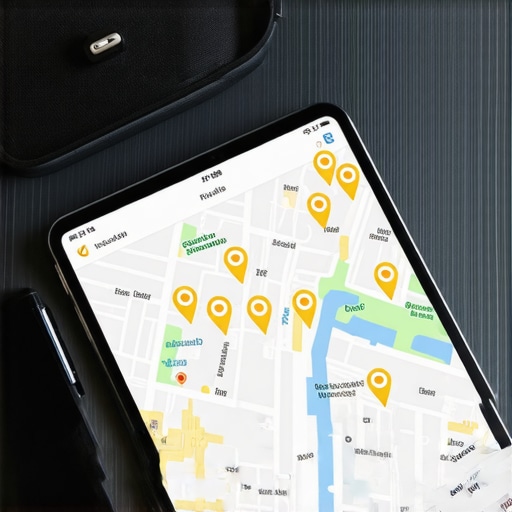
Digital location accuracy relies on the intersection of static NAP data and dynamic signal data from mobile users. If your coordinates are shifted by even a few meters, your business may vanish from the immediate proximity search results for high intent users. This microscopic math of GPS salience is why businesses often suffer. When your pin is placed on the wrong side of a building, the user intent signals do not align with the entry point. This creates a friction point in the data. You might notice why your google maps pin only shows up when customers are standing outside, which is a classic symptom of coordinate drift. The algorithm uses Wi-Fi triangulation and sensor data from every Android phone that passes your door to verify your existence. If the digital record does not match this physical flow, you are flagged as an anomaly. This is why the proximity glitch that keeps your pin from showing up is more than just a minor error; it is a fundamental breakdown in the trust loop between your business and the search engine.
“Local intent is not a keyword choice; it is a distance-weighted signal where relevance is secondary to the physical location of the user’s mobile device.” – Map Search Fundamental
Why your physical address is a liability
A physical address is no longer a guarantee of search visibility because the algorithm now prioritizes behavioral proof of presence over static documentation. Shared office spaces and poorly defined suite numbers create data noise that can lead to immediate profile suspension. Managing multiple locations requires an obsession with detail that most managers lack. A simple error in a suite number can cause the search engine to merge your profile with a competitor or ghost you entirely. You must understand how a simple suite number error can ghost your shop in local search to avoid the heavy hand of the spam team. I have seen multi million dollar brands lose forty percent of their leads because a cleaning service updated their address in a way that overlapped with the brand’s primary hub. This is why managing your brand when two maps profiles merge by mistake becomes a full time job for recovery specialists. You need google business profile recovery services that understand the logistics of address verification. Consistency is the only currency that matters. If your data is messy, your ranking will be stagnant.
The three mile radius that determines your revenue
Proximity remains the strongest ranking factor in the local ecosystem, creating a invisible boundary where your visibility drops off sharply regardless of your reviews. Expansion of this radius requires intense local signals that prove your relevance beyond your immediate neighborhood. Most managers are frustrated by why your maps boosting service radius is shrinking and how to expand it. It comes down to the density of your local authority. If you are not generating interactions within the specific blocks you want to target, the algorithm will pull your pin back to the centroid. You can use local seo boost techniques for better map rankings to push those boundaries, but it must be done with surgical precision. Traditional citations are failing to move the needle because they lack the behavioral component. Google wants to see users requesting directions from diverse locations. If all your traffic comes from the same three blocks, your growth is capped. You need map boosting service unlock local seo success today by focusing on hyper local content that speaks to individual neighborhoods. This is how you beat national chains that rely on broad, generic strategies.
Local Authority Reading List
- The only tools worth using for tracking local search success
- Why your google business profile interaction rate is tanking your map rank
- How to fix the signal gap keeping your shop out of the map pack
- 7 red flags to spot during your next local seo audit
- The simple checklist that pushed our clients into the local top 3
Surviving the keyword stuffing fallout
Keyword stuffing in business names is a violation of terms that leads to sudden ranking drops once a manual edit is applied or a competitor reports the listing. Normalizing your profile after an edit requires rebuilding trust through clean data and legitimate engagement signals. Many agencies sell local seo services to normalize rankings after keyword stuffed business name edit because the drop-off is often brutal. When you remove the artificial keywords, your profile must stand on its own merits. This is the moment when most businesses fail. They realize their organic authority is zero. You must use seo services to fix keyword stuffing and content issues before the algorithm catches up to you. I have audited hundreds of profiles where the manager thought they were being clever by adding their city name to the business title, only to be ghosted during the next core update. If you have a legacy of bad practices, you need seo services to clean legacy black hat local seo footprints to wipe the slate clean. The algorithm has a long memory. A single trace of map spam can haunt your coordinates for years.
Forensic auditing of user review patterns
Review sentiment and velocity are primary trust signals, but suspicious patterns like VPN usage or sudden spikes in five star ratings can trigger a filter that hides your feedback. Real local authority is built through consistent, geo tagged reviews from active local users. Many businesses are currently struggling with the review glitch that hides your five star feedback from potential customers. It is often not a glitch but a defense mechanism. If the person leaving the review has no history of being in your physical location, Google will likely discount the review. You must learn removing fake competitor reviews that are burying your business to keep your profile clean. I once saw a competitor drop fifty fake reviews on a client’s profile in one night. We had to prove the lack of GPS overlap to get them removed. If you are dealing with an attack, how to fight back against negative review attacks is the most important skill in your toolkit. Authentic interaction is the goal. Stop focusing on the number of stars and start focusing on the quality of the interaction. Canned responses are another trap. You can see why your canned review responses are hurting your search visibility by looking at how they fail to provide any new entity data to the search engine.
“Distance is the single most restrictive filter in the local algorithm, often overriding relevance and prominence when a user is within a five hundred meter radius of a competitor.” – Local Vicinity Research Group
The verification loops that kill multi unit brands
Multi unit brands face extreme scrutiny during the verification process, often getting stuck in a loop of failed video verifications and document requests. Keeping your documentation organized and your digital footprint consistent is the only way to survive these audits. Managers need to know the exact documentation you need for profile recovery before the suspension happens. Once a listing is gone, every hour of downtime is lost revenue. I have seen entire franchises go dark because one manager tried to change a phone number without verifying the secondary tier data. You should look into services to monitor and prevent future gmb suspensions to stay ahead of the algorithm. If you are already suspended, google maps seo services for suspended profiles are your only hope. The verification team is overworked and relies on automated triggers. If you do not hit the specific marks they are looking for, your ticket will be closed without resolution. This is where how to get a real response when your google business support ticket stalls becomes essential knowledge for any multi location director.
Tracking the real signals of foot traffic
Clicks and impressions are vanity metrics that often distract from the real goal of driving physical foot traffic and phone calls. Accurate tracking requires mapping digital interactions to real world conversions through advanced spatial analytics. Most google business profile ranking software only shows you a grid of green dots, but those dots do not pay the bills. You need to stop counting clicks and start tracking these 3 local conversion signals. If people are seeing your profile but not clicking the directions button, your relevance is failing. You must understand why ranking first fails if nobody ever clicks the directions button. It usually means your photos or your primary category are misaligned with user expectations. I recommend the only software we trust to map your real foot traffic because it integrates with POS data. This allows you to see the direct ROI of your local search efforts. If your multi unit brand has invisible locations in your analytics, you are flying blind. Tracking stop tracking rankings and start measuring real local search roi instead is the sign of a mature marketing operation.
Moving beyond the traditional citation
Traditional citations on dead directories no longer influence map rankings as much as niche, high intent signals from local entities. Building topical authority requires connecting your business to the specific neighborhood fabric through localized content and relevant backlinks. You can find finding niche citation sources that actually improve your map placement by looking at where your competitors are getting their neighborhood signals. The days of blasting your NAP data to a thousand sites are over. In fact, why most local citation sources fail to move the needle anymore is a common topic in my strategy sessions. You need to focus on the niche citation move that actually outranks your biggest competitor. This often involves local news mentions or sponsorship of neighborhood events that generate geo-relevant backlinks. Use the backlink strategy that actually pulls your map pin into the top 3 to build a moat around your locations. If you are just doing what everyone else is doing, you will never break out of the pack. You need expert map ranking help for dominating local searches to navigate this shift toward entity-based search.
A checklist for the local recovery
Recovering from a ranking drop or a suspension requires a systematic audit of your digital presence from the GPS coordinates up to the schema markup. Every signal must be normalized to ensure the search engine can trust your data once again. Start with how to audit your map ranking before hiring a pro. This will save you thousands in unnecessary fees. If you find errors, implement a practical plan for recovering from a search penalty. Do not rush the process. Google needs to see a consistent pattern of improvement before they will restore your visibility. You should also check the specific moves to fix stalled map rankings if you have been stuck in the fourth or fifth position for months. Often, the solution is as simple as the specific image changes that force searchers to click your map pin. High quality, customer uploaded photos provide the visual proof that the algorithm craves. Finally, ensure your technical foundation is solid with the specific footer code that finally puts your shop on the map pack. This binds your physical location to your digital domain in a way that AI overviews can easily parse.