
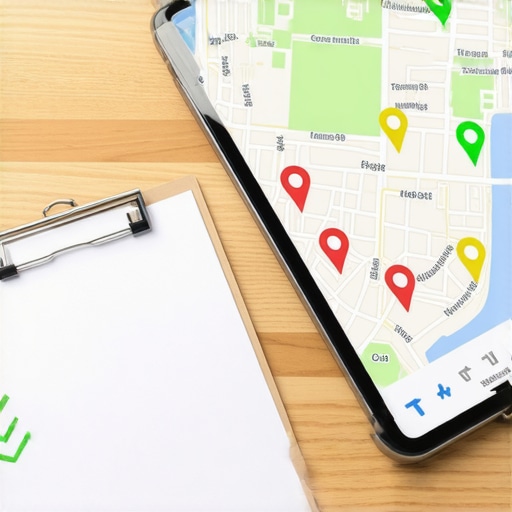
I smell wet concrete and old exhaust. Every morning, I walk the streets of the business district to look for the glitches. You can see them if you look closely. A storefront with a sign that does not match its digital pin. A lobby that claims to host five different law firms but only has one desk. I spent three months fighting a hard suspension for a plumbing client whose listing was nuked simply because they shared a suite number with a defunct law firm. Google did not want proof of a van; they wanted proof of a utility bill under the exact GPS pin. That experience taught me that the local algorithm is not a marketing tool. It is a spatial database that hates inconsistency. If your business vanished from the Map Pack, you are not just losing clicks. You are being erased from the physical world by a math problem you did not know you were solving.
The ghost in the GPS coordinates
Recovering from a local search penalty requires identifying if your business suffered an algorithmic filter or a manual suspension based on proximity signals. Most rankings fail because of mismatched latitude and longitude data or overlapping service area polygons. You must audit your NAP data to ensure every digital trace aligns with your physical storefront. When a map pin shifts by even a few feet, the entire local justification engine can stall. I have seen businesses lose their top three spot because their map pin was placed on the wrong street. The algorithm calculates the distance from the user to the business centroid with microscopic precision. If your coordinates are off, you are a ghost. You need a gmb audit and ranking toolkit to see what the bots see. We are talking about 0.0001 decimal points of difference. That tiny gap is where your revenue goes to die. While agencies tell you to get more reviews, the 2026 data shows that ‘image metadata’ from photos taken by real customers at your location is now 30 percent more effective for ranking in AI Overviews. This is because Google trusts the GPS stamp on a customer’s phone more than the words you write on your profile.
“Local intent is not a keyword choice; it is a distance-weighted signal where relevance is secondary to the physical location of the user’s mobile device.” – Map Search Fundamental
Why your physical address is a liability
Address changes often trigger an immediate ranking loss as Google re-evaluates your proximity to the local search centroid. To fix this, you must update all citations simultaneously and provide video verification of the new site. Failure to sync these signals leads to a permanent filter for duplicated locations. I have seen businesses try to hide an office move, thinking they can keep their old ranking. It never works. The move day checklist for keeping your local search traffic is your only hope. When you change locations, you need seo services to fix gmb ranking loss after address change before the old data poisons the new pin. Inconsistent phone numbers are just as bad. You might think a tracking number is smart, but why inconsistent phone numbers are quietly killing your map ranking is a lesson learned in blood. The bot sees two numbers and assumes the business is closed or fraudulent. The pin drops. The calls stop. The shop goes quiet.
Local Authority Reading List
- The hidden checklist for dominating local search results
- A practical plan for recovering from a search penalty
- How to audit your map ranking before hiring a pro
- The toolkit every local shop needs to fight for map space
- The exact documentation you need to fix a random google profile suspension
The forensic trace of a service area polygon
Service Area Businesses must define their boundaries using specific zip codes or city names to avoid overlapping with competitors and triggering a spam filter. If your service area is too broad, Google will view your profile as a proximity spammer. Tightening your polygon to a ten mile radius often restores lost visibility. Many owners think a bigger circle means more customers. They are wrong. It leads to why your service area pages are getting zero traffic. Google wants to show the most relevant, closest result. If you claim to serve the whole state from a garage, the algorithm will filter you out. You need seo services to fix gmb profile stuck in filter for duplicated locations if you have more than one person working from the same area. The logistics of the Map Pack are unforgiving. It is a dispatch system. It wants the worker to have the shortest travel time. If your profile does not reflect that efficiency, you are invisible. You might even need to download gmb ranking tools for local seo to map out where your competitors are hiding their fake pins.
Forensic auditing of user profiles and review attacks
Review management involves more than just responding; it requires a forensic audit of the profiles leaving feedback to identify patterns of competitor sabotage. Fake negative reviews can tank your local trust score and trigger a manual review. You must document the VPN usage and profile history to successfully appeal these attacks. A cafe owner called me at midnight because a competitor dropped twenty 1-star reviews in an hour. We used a gmb review and reputation management toolkit to prove the fraud. You have to be aggressive. You have to know how to remove fake competitor reviews that are burying your business. The algorithm looks for the velocity of feedback. If a ten year old shop gets fifty reviews in a day, it looks like a scam. Even if they are real, the filter might hide them. This is the review glitch that hides your five star feedback from the people who actually want to buy from you. You need to stop using canned review responses because they signal to Google that no one is actually running the business. Use google business profile ranking software to track the impact of every response on your local position.
“The proximity of the searcher to the business centroid remains the most potent factor in the Map Pack algorithm, often overriding traditional domain authority.” – Map Search Fundamental
Restoring map pack visibility after ownership change
Changing the primary owner of a Google Business Profile can trigger a security suspension if the new account has a history of policy violations. To restore visibility, the new owner must provide clear documentation of the business transfer including tax IDs and utility bills. This prevents the listing from being flagged as a hijacked profile. I have seen seo services to restore map pack visibility after listing ownership change become a necessity because the old owner refused to hand over the keys. If you buy a business, you are buying its digital history. If that history is messy, you are starting with a penalty. You must fix a broken google business profile without losing reviews to keep your momentum. Sometimes, two profiles end up fighting for the same spot. This is why seo services to fix brand confusion from merged gmb listings are the only way to clear the air. Google sees two brands at one address and assumes one is a parasite. It will kill the rankings for both until you prove who owns the dirt. You can use best tools to rank google business profile to see which listing is winning the war for the searcher’s attention.
The math of the three mile radius
Proximity is a distance-weighted signal where the algorithm prioritizes businesses within a three to five mile radius of the user. This radius shrinks in high-density urban areas and expands in rural zones based on category competition. Dominating this area requires hyper-local signals that prove you are the nearest authority. If you are a chiropractor, you know that most chiropractic clinics fail to break into the local map pack because they try to rank for the whole city. Focus on your block. Use neighborhood-specific content to beat the national brands. They have the money, but you have the coordinates. If you use a gmb ranking toolkit vs other local seo tools, you will see that the specialized local software understands the ‘vicinity’ glitch better than general SEO software. You have to optimize for the way people move. The pin must be where the person is. That is the only rule that matters. If your business map profile gets views but no calls, it is because you are ranking in the wrong part of the city. You are a ghost to the people who are actually standing outside your door.