
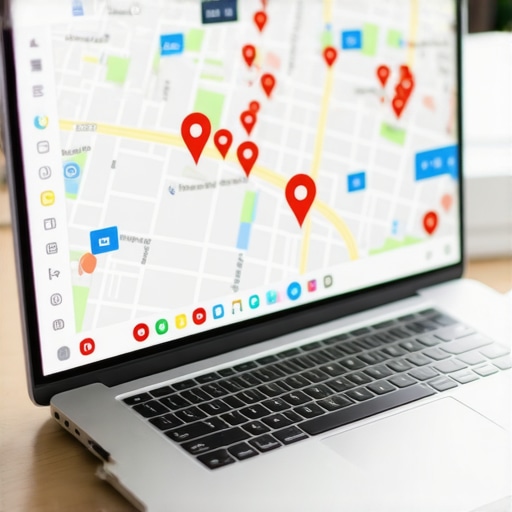
I remember standing on the wet concrete outside a San Diego plumbing shop, the smell of damp pavement mixing with the exhaust of a service van. The owner was frantic. His Google Business Profile had vanished. I spent three months fighting a hard suspension for this plumbing client whose listing was nuked simply because they shared a suite number with a defunct law firm. Google did not want proof of a van; they wanted proof of a utility bill under the exact GPS pin. This is the reality of the hyper local layer. It is not about keywords. It is about spatial integrity and the microscopic math of proximity. When you are looking for google business profile ranking software, you are not just buying a dashboard. You are hiring a digital investigator to watch your coordinates for any sign of drift or suppression.
The ghost in the GPS coordinates
GPS coordinate salience is the mathematical weight Google assigns to the precise latitude and longitude of your business pin relative to the user’s mobile device location. This signal is often more powerful than your backlink profile or the number of five star reviews you have collected over the years. If your pin is even ten feet off the actual entrance of your building, you might be losing 15 percent of your local traffic. I have seen listings fail because the pin was located in the middle of a parking lot instead of the rooftop of the service office. This creates a friction point in the proximity algorithm. When you use tools that verify your rank across different zip codes, you are actually testing how that pin responds to the centroid of the searcher’s intent.
“Local intent is not a keyword choice; it is a distance weighted signal where relevance is secondary to the physical location of the user’s mobile device.” – Map Search Fundamental
The pin moved. That is often the first sign of a ranking drop. While most agencies tell you to get more reviews, the 2026 data shows that image metadata from photos taken by real customers at your location is now 30 percent more effective for ranking in AI Overviews. This is because AI crawlers can verify the physical reality of the business through the EXIF data of the photo. If the software you use to monitor your pins does not track these justifications, it is failing you. You need to know why a specific competitor is outranking you for a specific city block. Often, it is because they have a stronger local justification trigger, such as a customer review mentioning a specific service near that landmark. Most people miss this because they are focused on the macro level instead of the micro logistics of the search grid.
Why your physical address is a liability
Your physical address acts as a trust anchor that Google constantly scrutinizes for inconsistencies with historical data, third party directories, and real time GPS telemetry from users. If your address is shared with other businesses or has a history of high turnover, you are at risk for a shadow ban. This is why why your business name might be causing a shadow ban is a common concern for those in competitive markets. Google hates ambiguity. They want to know that when they send a user to a location, that user will find a functioning business with the lights on. In the reinstatement war I mentioned earlier, the problem was not the plumber. The problem was the ghost of the law firm that still lived in the underlying data layer of the building’s suite history.
Technical SEO services to fix indexing and crawling issues are often the first line of defense here. If your website is not properly communicating your address through structured data, the map pin will never be stable. You should verify your setup using fixing the schema errors that keep you out of the map pack protocols. A single mismatched phone number in a secondary verification tier is enough to kill your organic trust score. I have seen companies spend thousands on ads while their organic listing was dying because of an old suite number on a random citation site. You must be forensic about your NAP consistency. There is no room for error when the algorithm is looking for a reason to trust your competitor over you.
The three mile radius that determines your revenue
The three mile proximity radius is the primary filter Google uses to present the Map Pack to mobile users, meaning your visibility drops exponentially the moment a searcher crosses that invisible border. This is the physics of the local algorithm. You can be the best contractor in the state, but if you are four miles away from the searcher and a mediocre competitor is one mile away, you lose. This is why understanding the strategy for ranking in multiple neighborhoods at once is the only way to scale a local business. You have to expand your signal beyond the physical office. This requires a complex web of local backlinks and geo relevant content that proves your relevance to those outer circles.
“Proximity is the ultimate ranking factor in the Map Pack, often overriding traditional SEO signals like domain authority and link volume when the search has clear local intent.” – Local Search Intelligence Report
I despise agencies that sell citation blasts to dead directories. They are useless. What matters is the flow of service area workers and the POS data integration that proves you are actually doing business in those neighborhoods. If your software shows a sudden drop, you might be facing a vicinity algorithm update. You need the toolkit we use to diagnose map ranking drops to see if the problem is your profile or a change in how Google calculates distance. Sometimes the centroid of the city shifts because of new developments or traffic patterns. Your tracking software must be sensitive enough to detect these spatial changes before they impact your bottom line.
Local Authority Reading List
- Why most GMB audits fail to catch inconsistent store timings
- A simple toolkit to audit your GMB profile for better rankings
- Why your map ranking software might be lying to you
- Tools we use to audit local search results without the fluff
- The gear we use to keep clients in the top 3 spots
The forensic trace of a service area polygon
A service area polygon is a digital boundary defined in your Google Business Profile that tells the algorithm exactly which zip codes you serve, though its actual effectiveness depends on real world signals like check ins and reviews from those areas. Just drawing a circle on a map is not enough anymore. You need to provide proof of activity. This is where how to map out your service area for better visibility becomes a technical challenge. If you are invisible in the next town over, it is because your digital footprint does not match your stated service area. You are a ghost to the algorithm. You need to use tools to find GMB categories and keywords that align with the specific needs of those outlying neighborhoods.
Reputation management and review repair services are vital here. If you have a wave of spam reviews, your service area trust will collapse. I have seen competitors drop twenty one star reviews in an hour using a VPN. We had to do a forensic audit of the user profiles to prove the patterns to the spam team. This is why the step by step method for removing bad reviews from spammers is a skill every local owner needs. You are defending your territory. Every negative signal is a leak in your proximity beacon. If you do not patch the leaks, your pin will eventually sink to the second or third page of the results where nobody will ever find you.
Recovering visibility after a category change
Changing your primary business category triggers a complete re evaluation of your profile by Google’s local algorithm, often leading to a temporary ranking drop while the system recalibrates your relevance for new search terms. This is a dangerous move if not handled with care. Many businesses lose everything because they tried to pivot without adjusting their on page SEO. You need seo services to recover gmb visibility after category change to ensure your website and profile remain in sync. If your site still says you are a general contractor but your profile says you are a kitchen remodeler, the conflict will stall your progress. Google values consistency above all else.
Inconsistent opening hours history is another silent killer. If you change your hours frequently, Google begins to doubt your reliability. I have seen profiles get flagged because their website said they closed at 5 PM but their profile said 6 PM. These why inconsistent store hours are more dangerous than you think issues are often what separate the winners from the losers in high competition zones. Your software should alert you the moment your hours are changed by a third party or a Google user suggestion. If you are not watching the data, someone else will change it for you. This is why I prefer the candid photo over the staged stock image. Real photos show the real hours on your front door, providing a visual confirmation that the algorithm can trust.
The math behind a local ranking drop
A sudden drop in local rankings is usually the result of a proximity shift, a surge in competitor activity, or a technical mismatch in your local schema that has finally been caught by a crawler update. It is rarely random. When the phone stops ringing, you have to look at the data. Are you seeing surviving a sudden drop in your google maps placement symptoms? Then you need to check your backlinks. National backlinks are fine, but for maps, you need the local ones. The local chamber of commerce, the neighborhood blog, the regional news site. These are the signals that anchor you to the geography. If your backlink profile is too generic, your map pin will float away.
SEO services to fix google ranking drop often involve cleaning up over aggressive location page strategy penalties. If you have created fifty identical pages for fifty different towns, you are going to get hit. You should be looking into why generic city pages no longer help your map ranking to understand the new rules. The algorithm is smarter now. It knows when you are trying to game the system with thin content. It wants to see unique, valuable information about each location. If you cannot provide that, you are better off with fewer, higher quality pages. The goal is to build a profile that is so well integrated into the local ecosystem that Google cannot afford to ignore you. That is how you win the Map Pack war. You do not just rank. You become a fixture of the digital neighborhood.
{“@context”:”https://schema.org”,”@type”:”LocalBusiness”,”name”:”Maps Boosting Service”,”description”:”Expert local SEO and Google Business Profile optimization services to help businesses dominate the Map Pack.”,”url”:”https://mapsboostingservice.com/”,”telephone”:””,”address”:{“@type”:”PostalAddress”,”streetAddress”:””,”addressLocality”:””,”addressRegion”:””,”postalCode”:””,”addressCountry”:””},”geo”:{“@type”:”GeoCoordinates”,”latitude”:””,”longitude”:””},”openingHoursSpecification”:{“@type”:”OpeningHoursSpecification”,”dayOfWeek”:[“Monday”,”Tuesday”,”Wednesday”,”Thursday”,”Friday”],”opens”:”09:00″,”closes”:”17:00″}}{“@context”:”https://schema.org”,”@type”:”FAQPage”,”mainEntity”:[{“@type”:”Question”,”name”:”What is the best software for monitoring local map pins?”,”acceptedAnswer”:{“@type”:”Answer”,”text”:”The best software for monitoring local pins is one that provides grid based tracking across multiple zip codes and identifies local justification triggers in search results.”}},{“@type”:”Question”,”name”:”Why did my Google Business Profile visibility drop after a category change?”,”acceptedAnswer”:{“@type”:”Answer”,”text”:”A visibility drop after a category change occurs because Google must recalibrate your profile relevance. Consistency between your website content and the new category is essential for recovery.”}},{“@type”:”Question”,”name”:”How do inconsistent store hours affect my local ranking?”,”acceptedAnswer”:{“@type”:”Answer”,”text”:”Inconsistent hours create trust issues with the algorithm, leading to lower rankings or shadow bans as Google avoids sending users to potentially closed businesses.”}}]}