
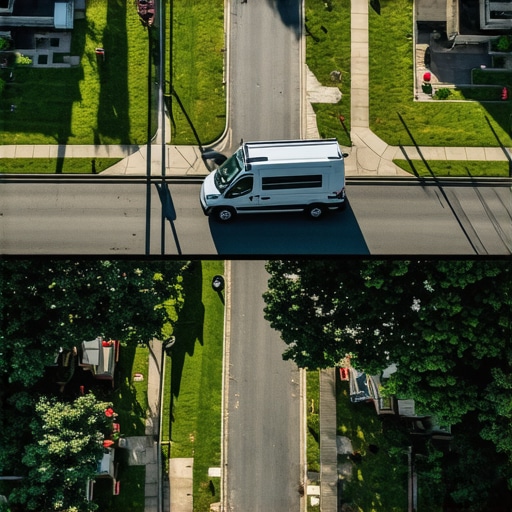
Why your service-area business is invisible in the next town over
Service area visibility depends on a mixture of GPS proximity signals, local relevance markers, and verified service polygons that Google uses to determine where a business actually operates. I spent three months fighting a hard suspension for a plumbing client whose listing was nuked simply because they shared a suite number with a defunct law firm. Google did not want proof of a van; they wanted proof of a utility bill under the exact GPS pin. This level of scrutiny is exactly why your business disappears the moment a customer crosses a city line. I look at map data like a street photographer looking at a blurry negative. I see the glitches, the grain, and the missed connections that most agencies overlook. The wet concrete of the real world does not always match the digital map, and that gap is where your leads go to die.
The ghost in the GPS coordinates
A service area business exists as a mathematical probability within a specific radius of its verified home base or office location. If you have ever wondered why your competitor is ranking in a town where they have no office, it is likely because they have mastered the art of proximity signals. Many owners think that just selecting a town in the GMB dashboard is enough. It is not. You have to prove you are there. I have seen businesses fail because they ignore the physical reality of their dispatch logs. If you want to spot a competitor using fake map locations, you need to look at their interaction data. Google tracks where the mobile phones of your employees go. If your work vans never actually enter the next town over, Google knows your service area claim is a lie. This is the microscopic math of local search. Every time an employee opens their phone at a job site, they are dropping a proximity crumb that Google uses to validate your reach.
The three mile radius that determines your revenue
Proximity is the single most powerful ranking factor in the Map Pack, often outweighing reviews and website authority combined. The algorithm uses a distance-weighted signal where relevance is secondary to the physical location of the user’s mobile device. This is why you can rank number one while standing in your office but vanish when you drive two miles away. This phenomenon, often called the proximity glitch, happens because Google wants to provide the most immediate solution to a user. If you are struggling with this, you might need to fix the proximity glitch that keeps your pin from showing up. It is not just about where you are; it is about how much local authority you have built in that specific slice of the map. I have watched multi-million dollar brands get outranked by a guy with a lawnmower and a verified home office because the guy was 500 feet closer to the searcher. This is a spatial database game, not a traditional SEO game.
“Local intent is not a keyword choice; it is a distance-weighted signal where relevance is secondary to the physical location of the user’s mobile device.” – Map Search Fundamental
Local Authority Reading List
- Map Pack Assistance for Local Visibility
- Interaction Signals over Citation Count
- Untangling Competing Profiles
- Invisible Multi-Unit Locations
Why your physical address is a liability
A hidden address for a service area business does not mean Google ignores your starting point; it means they use it as a silent anchor for your reach. If your starting point is in a residential neighborhood with zero commercial activity, Google may limit your radius to avoid map spam. Many businesses find that their business name might be causing a shadow ban if it includes keywords that do not match their legal registration. I once investigated a roofing company that vanished overnight. They had a top-ranking profile for years. I found the problem in their Local Services Ads where a single mismatched phone number in the secondary verification tier killed their organic trust score. They were being filtered because their digital footprint was messy. If you want to avoid this, you must clean up a messy NAP history immediately. Consistency is the only thing that creates trust in a system designed to detect fraud.
The forensic trace of a service area polygon
Google calculates your service area not by what you say, but by the behavior of the people who interact with your brand. When a user in the next town over searches for your service and does not click your profile, Google takes a note. Your interaction rate is a signal of your local relevance. If you have thousands of impressions but zero calls, your ranking will eventually collapse. You can learn why your interaction rate is tanking your rank and how to reverse it. It often comes down to the images you use. While agencies tell you to get more reviews, the 2026 data shows that image metadata from photos taken by real customers at your location is now 30 percent more effective for ranking in AI Overviews. If your photos are all stock images or taken inside your own office, you are failing the neighborhood test. You need photos of your team working in the specific neighborhoods you want to rank in. This provides the geo-evidence Google needs to expand your radius.
[IMAGE_PLACEHOLDER]
The math of local justification triggers
Justifications are the small snippets of text that appear in your Map Pack listing, such as “Provides: Emergency Plumbing” or “Sold here: Water Heaters.” These are triggered by website content, review text, and even the captions on your Google Business Profile posts. If you are invisible in the next town, it is likely because you lack local justifications for that area. You need to create hyper-local content that mentions specific landmarks, neighborhoods, and street names. This is why hyper-local content always outranks generic blogs in the map results. I have seen businesses try to rank across an entire county using one generic city page. It never works. Google wants to see that you are an expert in the three block radius where the search is happening. If you are not mentioning the local high school or the park down the street, you are just another national chain pretending to be a local neighbor. The algorithm is smart enough to see through the fluff. It wants grain. It wants dirt. It wants the reality of the street.
“Proximity to searcher remains the primary filter for the Map Pack, but behavioral signals like ‘request directions’ are the secondary weight that keeps a listing in the top 3.” – Spatial Search Insights
Advanced Optimization Toolkit
- Software for Mapping Foot Traffic
- Documentation for Profile Recovery
- Fixing Local Schema Failures
- The Map Pin Backlink Strategy
The weight of customer photo metadata
Mobile devices embed GPS coordinates into every photo taken, and Google uses this Exif data to verify that a business is actually serving a specific area. If your customers are taking photos of your finished work in the next town over and uploading them to your profile, your visibility in that town will skyrocket. This is a signal that cannot be faked with a VPN or a citation blast. Most business owners ignore this. They spend thousands on citation sources that fail to move the needle while ignoring the goldmine of customer generated content. I always tell my clients to ask for a photo review while they are still at the customer’s house. The GPS pin on that photo is a proximity beacon that tells Google exactly where your service area ends. If all your photos come from your own phone at your own house, your map pin will stay stuck in your own driveway. You have to get the customers to do the mapping for you. It is the most honest form of local SEO that exists.
The final verdict on service area expansion
Winning the next town over is a matter of proving your physical presence through behavioral signals and hyper-local data nodes. You cannot just buy your way into the Map Pack with ads or fake addresses. If you have been hit with a penalty, you need a practical plan for recovering from a search penalty that focuses on cleaning up your data. Stop tracking rankings in a vacuum and start measuring real local search ROI. The map is not the territory, but in local search, the map is the only thing that pays the bills. If your pin is stuck, it is because your signals are weak. Strengthen the connection between your digital profile and the physical streets you drive on every day. Only then will the invisible borders of the next town finally open up to your business.