
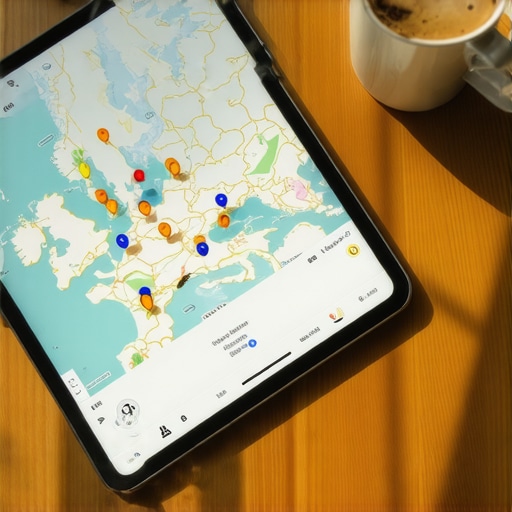
The ghost in the GPS coordinates and how to track it
Everyone wondered why a top-ranking roofing company vanished from the Map Pack overnight. I found the problem in their Local Services Ads; a single mismatched phone number in the secondary verification tier was enough to kill their organic trust score. In my twenty years of tracking proximity beacons, I have seen hundreds of businesses fall into this centroid collapse. A business listing is not just a digital profile; it is a spatial data point that requires constant forensic observation. If you are not looking at your map visibility every morning, you are essentially flying a plane without a radar. The local algorithm treats a three mile radius like a physical boundary where your relevance decays as the user moves further away from your pin. To stay visible, you must understand the mathematics of distance weighted signals and the forensic trace left by your competitors.
The morning ritual of local search monitoring
Google Business Profile monitoring requires a Local Search Grid to visualize Proximity Signals across specific GPS Coordinates. By using a GMB Ranking Toolkit, you can identify a Map Pack Drop caused by Algorithm Volatility or Competitor Spam before it impacts your daily lead flow and revenue.
Checking your status manually is a fool’s errand. When you search from your office chair, you are seeing a biased result based on your own location. A professional strategist knows that the map looks different from the coffee shop two blocks away and the highway three miles east. You need software that can spoof geographic locations to show you the ground truth. This is integral because the local justification triggers, those little snippets of text that say ‘their website mentions…’, are often tied to the specific intent of the searcher in that micro-neighborhood. If you find your visibility slipping, you might need the move that restores your map rank after an update to correct the trajectory. I often tell my clients that a map pin is like a lighthouse; it only works if the signal is consistent across every cardinal direction. If your data is messy, your lighthouse goes dark.
“Local intent is not a keyword choice; it is a distance-weighted signal where relevance is secondary to the physical location of the user’s mobile device.” – Map Search Fundamental
Understanding what is a gmb ranking toolkit
A GMB Ranking Toolkit is a collection of Location Intelligence software designed to audit NAP Consistency, track Geographic Heat Maps, and perform Sentiment Analysis on reviews. These Local SEO Tools help identify Shadow Bans caused by Keyword Stuffing or Duplicate Listings in the Map Pack.
The right toolkit does not just show you a number from one to ten. It shows you a grid of dots over your city. Each dot represents a search conducted at a specific latitude and longitude. Green dots mean you are in the top three; red dots mean you are invisible. This granular view is the only way to see the ‘proximity bleed’ where your ranking starts to fail. Many owners rely on generic software, but why your map ranking software might be lying to you is a topic every serious merchant should study. Often, these tools use data centers rather than local IP addresses, leading to false positives. To fix this, you need a professional map ranking toolkit that mimics real human behavior. I have seen businesses celebrate a number one ranking on their dashboard while their phones remained silent because the software was not tracking the actual service area.
Local Authority Reading List
- How to fix the signal gap after changing your service area
- Spotting map spam before it tanks your local visibility
- Tactics for keeping your ranking steady during an expansion
- How to repair your reputation after a staff mistake goes viral
- Why your map pack placement drops every weekend
How to spot map spam before it tanks your local visibility
Map Spam Fighting involves identifying Fake Business Profiles, reporting Address Rentals, and removing Keyword-Stuffed Business Names that violate Google Terms of Service. This Forensic Audit protects your Local Search Visibility by clearing Illegitimate Competitors from the Map Pack grid for your primary keywords.
Spam is the silent killer of legitimate local shops. In some high-competition niches like locksmiths or personal injury lawyers, up to fifty percent of the listings in the Map Pack are ghosts. These are businesses with no physical presence, often operating out of P.O. boxes or shared coworking spaces where no one actually works. If you see a competitor suddenly jump twenty spots in a week with a name like ‘Best Plumbing Repair City Name’, they are likely gaming the system. You should be spotting map spam before it tanks your local visibility by checking their street view data. If the pin is in the middle of a parking lot or a residential house but they claim to be a retail store, it is time to file a redressal form. I spend hours digging through user profiles to see if their reviews are coming from a farm in another country. It is gritty work, but it is the only way to keep the ecosystem clean.
“The proximity of a business to the user is the primary factor in the local algorithm, often outweighing traditional organic signals like backlinks or domain authority.” – Vicinity Algorithm Whitepaper
The tools that verify your rank across different zip codes
Zip Code Tracking uses Geocoded IP Proxies to simulate Local Search Intent across multiple Neighborhood Centroids. These Local SEO Services provide a Spatial Analysis of how your Google Business Profile performs in High Competition Zones versus Suburban Areas far from your physical address.
Proximity is not a static circle; it is a warped shape influenced by traffic patterns, natural boundaries like rivers, and the density of competitors. To truly dominate, you must use tools that verify your rank across different zip codes with precision. If you are a plumber in one town, you might rank well in that zip code but disappear entirely once you cross the county line. This is often due to a lack of ‘local justification’ in your content. Google needs to see that you are active in those other areas through geo-tagged photos and location-specific reviews. If you are struggling with a missing map pack ranking in nearby towns, it is likely because your proximity signal is too weak to reach that far. You have to build the bridge with data.
Technical seo services to fix indexing and crawling issues
Technical SEO for local sites focuses on Crawl Budget Optimization, fixing 404 Errors, and ensuring Mobile Responsiveness for Hyper-Local Landing Pages. These Indexing Services ensure that Googlebot can correctly associate your Physical Address with your Digital Entities through Structured Data.
If the Google crawler cannot read your site, it cannot rank your map pin. Many businesses have ‘invisible’ pages because of messy code or slow servers. I have seen shops lose their entire ranking because of a broken redirect during a site migration. This is why 404 errors are the silent killer of local rankings; they break the link between your website and your map profile. You need to perform a listing audit for crawl errors at least once a month. This is not about the colors on your website; it is about the JSON-LD schema that tells the machine exactly who you are, where you are, and what you sell. Without that technical foundation, your map visibility is built on sand.